


By Lael M. Oldmixon, M. Ed., Executive Director, Education Trust of Alaska
July 16, 2024
As someone who appreciates the advantages of saving for education with a 529 plan and is a 529 account owner for my two beneficiaries, I applaud families who have diligently planned and contributed to a loved one’s account. When it comes to the pivotal moment of paying the first qualified expenses, account owners can spend less time stressing about how to pay for college by following these easy steps and more time celebrating the success of their savings journey:
Step 1: Calculate Your Qualified Education Expenses
529 plan account owners can withdraw any amount from their 529 plan, but only qualified distributions will be tax-free. The maximum amount you can withdraw tax-free is the total amount of qualified expenses paid during the year minus any amount used to generate other federal tax benefits.
- Add up expenses (e.g., college tuition, fees, books, supplies, equipment, computers, and room and board).
- Subtract tax-free educational assistance (such as scholarships or employer programs).
- Subtract expenses used to justify the American Opportunity Tax Credit (AOTC) or Lifetime Learning Tax Credit (LLTC).
The remaining amount is your maximum withdrawal amount. You should consult a tax professional or financial advisor to learn more about how tax-free educational assistance and tax credits may impact your 529 withdrawal.
Step 2: Time the Withdrawal
Withdraw your funds in the same calendar year you plan to use them so that the year’s withdrawals align with the year’s education expenses. Be sure to keep all your receipts. Toward the end of the calendar year, review your expenditures to make sure you have withdrawn funds to cover all qualified expenses. Be sure to give your 529 plan administrator enough time to process your withdrawal request in the same calendar year (approximately 10 business days).
Step 3: Select the Recipient
Account owners are responsible for requesting the withdrawal and may choose to have the funds sent directly to the school, to the beneficiary, or to themself via check or ACH.
If you are sending the funds to the school, be prepared to provide your plan administrator with the beneficiary’s name, student ID, and the school’s name and address.
Step 4: Request the Withdrawal and Plan Ahead
Most plans allow you to request a withdrawal on the phone, online, or via paper form. Visit the plan’s website and review the options available to you.
- Some plans offer a service to expedite payments to schools via ACH or through an online withdrawal platform for a small fee. In my experience, the nominal fee is worth the freedom from worry.
- While mailing a check to the school may be free, it can take at least 10 business days to arrive and has the risk of getting lost in campus mail.
- Sending the funds directly to your bank account or via check to your home is an easy and free way to receive the withdrawal. However, you will still need to pay the school with a check, credit card (which may include a fee), or bank transfer. Avoiding this additional step may be worth any ACH fees described above.
Whichever method you choose, once you have finalized the withdrawal request, follow up with the school to ensure the funds hit the account, keep an eye on your bank for the funds to arrive, or watch for the check in the mail.
End-to-end, it’s recommended that you give yourself a buffer of about 10 business days. If the payment is due on August 15, consider making the request for withdrawal by about August 1.
Last fall, I wrote an article
about navigating the first year of college, which is a guide for both students and parents. While the tips may be most beneficial for your student, they may also be helpful for you!
Navigating the First Year of College: A Guide for Both Beneficiaries and Their Parents
Here’s a preview of the article:
Before Arriving
- Read all communications from your university or college.
- Review your admissions and financial aid status. Are all outstanding documents submitted?
- Watch for instructions about logistics like deposits, housing deadlines, fee payment, and class registration.
- Request your 529 distribution at least ten business days before the fee payment deadline.
Continue reading and print the complete list here.
About the author:
Lael M. Oldmixon, M. Ed., is the Executive Director of the Education Trust of Alaska, which offers Alaska’s three 529 plans: Alaska 529, the T. Rowe Price College Savings Plan, and the John Hancock Freedom 529. She lives in Alaska with her spouse, two children, and two dogs.
By Brittany Leona Parks, writer, my529
Are there any products available today that can truly improve financial, career, and mental well-being? Consider what a 529 college savings plan can do. Setting money aside to reduce or eliminate the need for student loans can benefit lives significantly.
Boost early income. Embarking on the adventure of your first job can be stressful enough without having to worry about a significant portion of that paycheck being unavailable. Students commonly believe they can worry about their student loans later. Unfortunately, the payments often come due simultaneous to other expenses in a young person’s life, like buying a car, relocating, or setting up a new home. This is also when early investments have the greatest potential for growth over time. These factors can have a crucial influence on future wealth and quality of life.
Set a strong foundation for life. The financial burden of student loans can delay other milestones like starting a family or buying a home. Gen X first experienced the burden of student loans, then Millennials, and now it shapes how Gen Z views the value of certain degrees or schools. For second-generation college graduates, parents’ outstanding student loan debt could have affected how much money their parents could set aside for them to attend school.
Find freedom and flexibility to optimize opportunities. Recent graduates likely saw their parents struggle economically during the Great Recession and, as such, understand that jobs are not distributed with diplomas. Allowing for some extra time to find the best position — rather than settling for just any job that will pay the bills — can boost lifetime earnings and accelerate career advancement. It can also give you the freedom to pursue a more fulfilling job, but perhaps it pays less.
Reduce the potential to feel financially overwhelmed. Student loans — just like any financial debt — can increase stress and lead to life-long and far-reaching negative consequences. Failing to keep up with student loan payments could ruin credit scores and result in garnished wages and Social Security benefits. Life can be challenging enough, and it’s unlikely that a recent graduate wouldn’t have, at the very least, some financial concerns. This can make facing decades of future bills feel particularly intimidating, especially if students understand how compound interest can change the equation.
Benefit from earnings — not accruing interest on a loan. If students can set aside money now, those compounding gains can work to their advantage. Demonstrating how saving pays off is a beautiful lesson that can also benefit future generations. It is important to remember that, on average, students who graduate with postsecondary degrees see higher earnings, more career opportunities, and better health outcomes — making the cost of higher education even more worthwhile.
Help your student be part of the over 30% who graduate from higher education without student loans and reduce the financial, career, and mental health burdens through investing early and often into a 529 college savings plan.
About the author:
Brittany Leona Parks is a writer for my529, Utah’s educational savings plan. When not researching financial best practices for children, she is trying these strategies out on her own two kids, hiking with her family, and participating in entirely too many book clubs. She previously spent 8 years marketing to the financial and legal sectors.
By Alyson Luszcz and John Mitchell, Co-Chairs, CSPN Data, Operations, and Technology Committee
Every year, a big group from our workplace (or office) gathers for a summertime outing at a Chicago White Sox baseball game. Some of the colleagues who join are baseball fanatics and others could not name one player on the team. Invariably, at least someone is attending the first baseball game in their life. As we talk over beer and peanuts, some colleagues admit to feeling sheepish about how little they know about baseball. As devoted baseball fans, we always tell them there’s nothing to be shy about and remind them that even the most passionate fan has many things left to learn about the game.
As it turns out, we see similar a similar phenomenon among those saving – and not saving – in 529 plans.
Across the broad American population, approximately 10% of households are estimated to be saving in a 529 plan.[1] Interestingly, an additional 23% of the population is estimated to be saving for college in other vehicles such as checking accounts and other tax-preferred accounts.
Why are so many families saving for college in something other than a 529 plan? In a 2022 survey commissioned by the College Savings Plan Network (CSPN), the most common reason families reported saving for college in anything other than a 529 was “unfamiliarity” with 529 plans. Given that nearly 1 in 4 families are saving for college but not in a 529, states and plan administrators have a lot of work to do to help more families understand all the benefits that 529 plans can offer, including tax-preferred growth, state-level tax advantages, professional designed investment options, and much more.
However, just as the most devoted baseball fan has many things left to learn about the game, the same CSPN survey found that approximately 60% of those currently saving in a 529 plan did not know at least one of the following advantages of 529 plans:
- Funds saved in a 529 can be used across all states in the US, not just at institutions in a 529 plan’s host state.
- 529 plans can be used for traditional 4-year colleges as well as 2-year colleges, graduate school, vocational school, technical school, and apprenticeships.
- Money saved in a 529 plan is not forfeited if not used to pay for education.
- 529 plans have a small impact on financial aid.
- Anyone can open a 529 plan – including parents, aunts, uncles, grandparents, friends, and other loved ones.
Clearly, 529 plans have additional work to do to help their current account holders fully understand the flexibility and benefits associated with 529 plans. The good news is that the survey found that 75% of account holders wanted their plan administrator to provide more information on the cost of college and effective strategies for maximizing savings.
As a state administrator and private-sector plan manager of 529 plans, we look forward to doing all we can to educate families – from those saving in a 529 plan today to those who have yet to hear about 529 plans – on the full range of advantages that 529 plans can offer.
Alyson Luszcz has over 20 years in the 529 industry and is currently AVP, Advisor-Sold Plan Program Manager at T. Rowe Price. She serves as Co-Chair of the CSPN Data, Operations, and Technology Committee and is based in Owings Mills, MD.
John Mitchell is Director of College Savings at the Illinois State Treasurer’s Office, where he oversees Illinois’ two 529 college savings plans: Bright Start Direct-Sold and Bright Directions Advisor-Guided. He serves as Co-Chair of the CSPN Data, Operations, and Technology Committee and is based in Chicago, IL.
[1] All statistics referenced in this blog post are taken from the CSPN National Survey of College Savers, released in May 2023 by the College Savings Plan Network. The survey was a nationally representative sample of more than 35,000 respondents. A public version of the report is forthcoming.
Last month, Washington, D.C. welcomed members of the National Association of State Treasurers (NAST) for their annual Legislative Conference. This gathering not only facilitated numerous networking opportunities but also featured engaging discussions with congressional leaders and subject matter experts. Attendees delved into current congressional priorities, honed their messaging and strategies, and explored the impactful role of advocacy led by Treasurers and their teams.
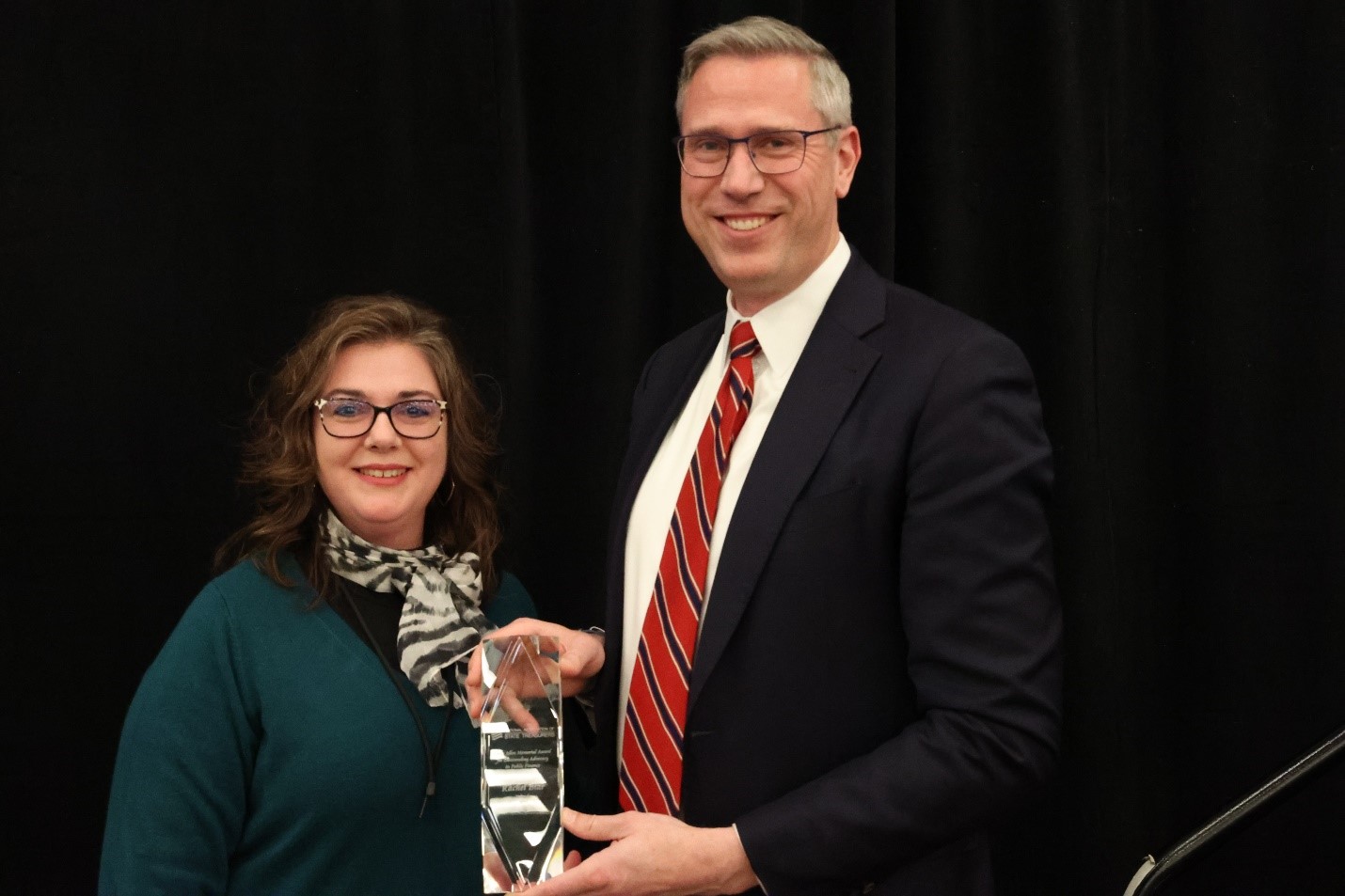
One of the highlights of this year’s conference was the presentation of the Chris Allen Memorial Award for Outstanding Advocacy in Public Finance to Rachel Biar, Assistant State Treasurer of Nebraska. This prestigious award is given to an individual from a state treasury, NAST member agency, or congressional staff who has demonstrated exceptional advocacy or advancement of NAST’s priorities over the past year.
Rachel, who recently served as Chair of the College Savings Plans Network (CSPN), has been instrumental in key advocacy efforts. These include advocating for CSPN during discussions on the 529-Roth IRA rollover provision, securing CSPN influence on child savings account proposals at the federal level, and supporting legislation that expands the use of 529 plans for workforce credentialing. Rachel’s dedication significantly contributed to NAST’s achievements in 2023.
Before the conference attendees dispersed to engage with Congress members individually, the conference concluded on a high note in a Capitol Hill hearing room, where Representatives Ron Estes (R-KS), Seth Magaziner (D-RI), and Rob Wittman (R-VA) shared insights into their legislative agendas. These discussions underscored broad support for ABLE savings plans and the expansion of 529 accounts for educational purposes. Representative Wittman, in particular, highlighted his personal connection to the issue through experiences with his son’s education, driving his advocacy for legislation that allows 529 funds to be used for credentialing programs.
In addition to focusing on college savings plans, the conference explored the evolving landscape of work and what the future may hold. Discussions also covered the implications of recent legislative developments like the Savers Match under Secure 2.0, particularly how these changes affect state-facilitated retirement programs given that Roth IRAs do not qualify for the new federal matching funds intended to support low-income workers in saving for retirement.
Overall, the NAST Legislative Conference was a resounding success, marked by insightful discussions, valuable learning opportunities, and robust advocacy efforts—all wrapped up in an engaging and enjoyable setting.
About the author:
Dillon Gibbons is the Director of Policy at the National Association of State Treasurers (NAST).
By Steve Jobe, Senior Vice President, Vestwell
February 20, 2024
Anyone who’s been or has sent a child to college knows firsthand how expensive obtaining a degree can be and how quickly that cost has risen. Just how big a problem is this? How can we address the damage already done? Who can help Americans avoid the burden in the future?
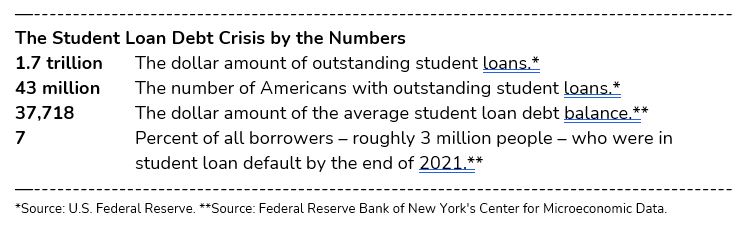
The amount of student loan debt is staggering. And, the number of Americans affected is significant – over 15% of adults in this country. Student loan debt is both a burden for American families and a drag on the country’s economy. Perhaps you’ve experienced this firsthand – did you put off contributing to your 401(k) because you had too many student loan payments left? According to Vestwell’s annual “Saving Trends Report, 93% of survey respondents with student loans reported that their student debt had affected their ability to save. Other common delays include moving out of the parents’ house, or buying a new car or a first home.
Employers to the rescue. Thankfully, there are workplace solutions to help employees repay their student loans. Employers have begun using services such as Gradifi, a benefit service that gives employers a simple, streamlined way to provide a match to employees who are still repaying their student loans.

Of course, the best way to reduce student loan debt is to incur little or none in the first place. So what can the average American do to best prepare for this future cost? Take advantage of the two things everyone has at their disposal: time and the tax benefits of a 529 plan.
One boost to incorporating 529s in the workplace has come from several states that provide tax credits to incentivize employers to promote savings in a 529 plan. Currently, Arkansas, Colorado, Idaho, Illinois, Nebraska, Nevada, and Wisconsin offer tax benefits to employers who match their employees’ contributions to a 529 plan. Along with this financial wellness strategy, many employers already make it easy to contribute to a 529 plan by allowing employees to make a contribution through the payroll process. These types of incentives are helping to spread the word about the benefits of saving for future education expenses instead of relying on student loans.
Why 529 Plans? As those who frequent this blog know, 529 plans are tax-advantaged savings plans to help offset the cost of higher education. They can be opened by anyone and assigned to any beneficiary – a child, a grandchild, a niece or nephew, a friend – even yourself or your spouse. 529 plans are sponsored by states, so their rules – such as tax incentives – differ from state to state. However, in all cases, the money grows on a tax-deferred basis. As long as it’s used for “qualified” education expenses, future withdrawals aren’t subject to either state or federal taxes. They can even be rolled into a Roth IRA now if eligible balances remain in the account.
However, according to the same survey, only 42% of savers are at least somewhat aware of the tax benefits of 529 Plans, and less than 5% of those surveyed with a Vestwell-managed 401(k) currently have one. So, while the benefits of starting a 529 plan are numerous, too many Americans need to be made aware of them, and fewer take advantage.
A 529 plan might be an effective way for you to help someone you love reduce reliance on future loans, and with many employers beginning to offer them as a part of their benefits and financial wellness offering, they can be set up easily to prepare for future educational expenses. Check with your benefits provider or HR department to ensure you are fully aware of all financial wellness benefits you may be eligible for. Open an account and start saving as soon as possible; regardless of how much you contribute, every dollar saved reduces the amount of student loan debt in the future.
About the Author
Steve Jobe is a Senior Vice President at Vestwell, where he oversees strategy and relationship management of the firm’s 529 and ABLE programs. Steve also serves on the College Savings Foundation’s Board and the Municipal Securities Rulemaking Board (MSRB)’s Municipal Fund Securities Advisory Group.
By Troy Montigney is Vice President of State-Facilitated Retirement Programs (SFRP) at Ascensus
January 3, 2024
Saving for any purpose is a big commitment, worthy of consideration with other long-term goals and any current needs. But even if current needs allow you to make a commitment, doubt can persist, especially when it comes to saving for education in a 529 plan.
The key what-if here, for many, seems to be “what if my loved one doesn’t actually go to college?” Thanks to new federal retirement savings legislation (SECURE 2.0) passed in 2022, another answer to that question takes effect in 2024: move their 529 savings to a Roth IRA.

Congress has a tall task before it to write personal savings policy that aids Americans in navigating many complex choices. But here, it built upon other 529 features like beneficiary changes and usability for trade and apprenticeship programs with the most transformative option yet – in effect, rewarding commitment to save for education with a clear path toward saving for retirement.
While I’d love to focus solely on this new law’s potential, there are some restrictions to keep in mind:
- Time. Your 529 account must be open for at least 15 years before you can make a 529-to-Roth rollover, so saving as early as possible is important. Also, 529 contributions from the last five years, including any associated earnings, are not eligible to be rolled over tax-free. Good things come to those who wait; in this case, you can simply delay the 529-to-Roth rollover to a later year.
- Dollar Limits. 529-to-Roth rollover dollars are subject to annual IRA contribution limits like any regular contribution. There’s also a $35,000 lifetime limit. So in 2024, assuming all other criteria mentioned here are met, you could transfer $7,000 of unused 529 money to a Roth IRA and still have $28,000 of rollover eligibility remaining in future years.
- Ownership. The 529 beneficiary and Roth IRA owner must be the same person, meaning you can’t use your beneficiary’s 529 to fund your own retirement savings. This requires a mindset that the money you’re putting into a 529 is truly for that person, no matter the eventual purpose.
- Income. Already a rule for regular IRA contributions, the Roth IRA owner must have annual earned income equal to or greater than the amount of the 529-to-Roth rollover.
Additionally, treatment of 529s for state income tax purposes can vary from state to state, so it’s important to double-check whether completing a 529-to-Roth rollover will lead to a clawback of any front-end state tax incentives you previously earned for your 529 contributions.
What does this look like in practice? Assuming a 529 beneficiary graduates at age 22 with some money left in her 529, the 529 was opened before she was seven years old, and she moves on to employment with earned income, she could make multiple years’ worth of IRA contributions without straining her budget as a recent college graduate. These early contributions and their decades of potential investment growth would be among the most impactful to her long-term retirement security.
My wife and I are old enough to face many complicated financial decisions year in and year out. (Personally, I’m also still young enough to remember feeling like I was falling behind when my first jobs didn’t offer 401(k)s, and scraping together IRA contributions alongside typical twenty-something expenses was a challenge!) Prioritizing our two young daughters’ 529 plans takes constant commitment, but knowing we could be supporting their retirement, too, is all the reward we need.
About the Author
Troy Montigney is Vice President of State-Facilitated Retirement Programs (SFRP) at Ascensus, which serves over 600,000 IRA savers via CalSavers and Illinois Secure Choice, and nearly seven million 529 accounts in 43 plans across 26 states and the District of Columbia. He previously directed Indiana’s 529 program and lives in suburban Indianapolis with his wife Sara, and daughters Sophie and Molly.